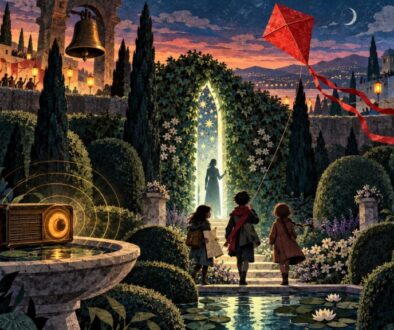
The Note That Wasn’t on the Map
“I can hear it even here—six notes, soft as breath,” I said, stepping off the shuttle into the weld-bright roar of the repair station. The concourse thrummed with carts and voices, but the little melody threaded the din like a needle.
“If you’re hearing music in this racket, you’ve got better ears than the rest of us,” the kid said from the shadow of a supply crate. They had a rigger’s harness slung crosswise and a grin that could cut foil. “You Ada Rowan? The musician-fixer?”
Crews were strapping panels for the blackout, counting down to the ion storm that would wipe long-range comms. Above the stained glass of the viewport, the Umbra Net’s filigree drifted—a silver lace between the station and the coming weather.
“Rowan,” the guardian called, boots ringing on the deck as he strode up with an authorization slate. “Ordinary assignment. East tether, grid four. Inspect seals, log battery states, do not deviate. We’re about to go dark and I won’t have treasure hunts on my watch.”
“If a treasure could save a tether, would we call it a hunt?” I asked, managing a smile. I tapped the side of my head. “There’s a tune I know, and it always meant ‘home’ to me. I heard it here before, years ago.”
“You heard ductwork complaining,” he said, not unkindly. “We keep this place from singing, Rowan. It’s safer that way. Do the job you were sent for.”
Background and context
“Sometimes the station hums on purpose,” Lio said, almost too soft to catch. Their gaze flicked toward an unmarked service gate and back. “Sometimes when a thing is erased, the only way it remembers itself is by humming.”
I stowed my kit in a locker that should have been empty. A paper scrap lay inside—paper, not polymer, creased and thumbworn: a hand-drawn route cut through the east decks and descended where no corridor should run.
“Who left you here?” I whispered, tracing the pencil lines, the arrowhead at the end labeled in tiny letters: hushfold. The word pricked a childhood corner of my mind like a sliver.
“Rowan.” Corin’s voice was steel. He’d followed, quiet for a big man. “I said no. That isn’t even a real section. It isn’t on any current map.” He held his hand out for the scrap.
“It’s a route somebody risked to draw,” I said, not surrendering it yet. “And the last time I heard these notes, I was small, and my mother was laughing, and an old vent spun warm air that smelled of solder and lemon.”
“Hushfold’s real,” Lio said, slipping between us like a cat. They tapped the corner of the scrap as if greeting an old friend. “Not in records, but in steel. They cut it out of the system and pasted clean over the hole.”
In my quarters, I set the scrap under my lamp, and when I reached for the tin whistle I had carried since childhood, my fingers found a twin—flawless, polished, without the hairline dent I’d made falling down a ladder at fourteen.
Key details
“This isn’t mine,” I said, and the breath I had meant to spend on a tune leaked out as a hiss. I lifted the imposter; it was perfect, so perfect it had no story in it at all. The melody died on its mouth.
“You’re rattled,” Corin said, but he held the instrument up to the light, and his eyes narrowed. “Someone went to trouble. Who knew you kept this here?”
“The counterfeits keep getting better,” Lio said. They ran a nail along the seam where wood met metal. “The screws have no bite marks. The varnish is one coat too even. Only a person who loves a thing knows its mistakes.”
The clock ticked toward blackout. In the docks, floodlights came up and a low siren thrummed. The Umbra Net would need to align before the storm’s front hit, or fragments riding the solar wind would tear holes clean through its lace.
“Then we stop the replacing long enough to ask our thief a question,” I said. I smoothed the scrap and slid it into a data sleeve with a painted corner only I would notice missing. “We stage a wrong answer and see who corrects it.”
“You have one hour,” Corin said at last, jaw set against his better judgment. “An hour to play hunter. Then you seal whatever rabbit hole you found and you get back to grid four. If anything compromises the Net, I shut it down.”
“We plant your sleeve where a careful ghost will find it,” Lio said, alight with the kind of joy that scares adults. “Inside, we leave a doctored map—close, but a centimeter wrong on the cut. They’ll fix it. We watch them fix it.”
We tucked the bait into a recycle cart near a maintenance node, then took cover above the concourse where the catwalk shadows broke the light. Corin pretended not to see us and posted a patrol facing the wrong way.
Wider impact
“There you are,” a man murmured, keeping his body between the cart and curious eyes. In the reflection on a panel, I saw a face I knew from a hundred dry briefings: Archivist Marek, who curated our past as if it were a fragile dish.
“I liked it better where it was,” I said, dropping from the catwalk. My boots hit loud, on purpose. I held the counterfeit whistle up like an accusation. “You copy what you can’t abide, and you think perfection will erase the rest.”
“Archivist Marek,” Corin said, stepping out of a shadow where a shadow shouldn’t have held him. His voice was the low unstruck bell that made crowds still. “Explain.”
“Hushfold was built wrong,” Marek said, and the careful mask he wore for years slid to show the frightened dreamer beneath. “It was ballast and memory, a waste of mass we couldn’t afford when the Net needed lightness. We erased it to save ourselves.”
“You erased it to own its door,” Lio shot back. “If no one knows a room exists, who checks what you do inside? You’re going to sever the old anchor and sell its alloys before the storm? The cut will make the Net lag and tear.”
The siren deepened. A tremor ran through the deck, the whisper of actuators starting the Net’s slow turn. The corridor lights flickered to amber, and the clock above the concourse slid from minutes to seconds.
“Safe plan: we lock the east decks and force the alignment without the ballast,” Corin said. He gestured to the ceiling where the Net’s pale threads hung like veins. “We lose some efficiency, but we don’t chase phantoms while the weather chews on us.”
What comes next
“Safe until it isn’t,” I said. I closed my eyes and let the six notes unfurl, not through the whistle but on my tongue, low and true. “Hushfold’s thrusters used to tune by ear—by this. My mother called it the ‘good-night song’ for old metal.”
“There’s a manual inlet on the erased deck where you can feed that tone,” Lio said, already unspooling a line from their harness. “Three short, two long, hold the last until you taste copper. The struts listen for it. They remember.”
We moved, not fast so much as true. Past the unmarked gate the hand-drawn line proved honest: a narrow spine, a ladder whose rungs were the color of first smoke, a door that opened to a room the maps insisted was air.
“Hello, old friend,” I said to the panel that should not have been there. The inlet behind it was keyed for a frequency and a promise. I sang the pattern and felt the floor shiver under my soles like a waking animal.
“Again,” Lio said, fingers flying over a faded bank that had slumbered long enough to collect dust like velvet. “Short, short, short—now—long, long. There, see? The indicator’s biting. Keep her steady. She’s shy.”
“Rowan, if this goes sideways—” Corin began, but he was already bracing a spar with his shoulder so a stubborn latch could clear. Sweat slicked his temple, and in it I saw a man arguing with a lifetime of training and losing.
The storm’s first teeth scraped the Net. For a breath the whole station seemed to tilt, the way a house breathes before a gale. The room around us sighed; something old found its socket. The hum leveled and took a deeper note.
“You’ll unhide it,” Marek said, despairing and small in the ruin of his certainty. His hands hovered, then dropped. “You’ll put Hushfold on the map and every opportunist will gouge it for parts. I thought secrecy was safety.”
“Maps can be honest without being invitations,” I said, letting the last long note trail to silence. “We can mark Hushfold true and post a lock that listens for care instead of keys. Trust isn’t a storm door you bolt and forget. It’s a thing you keep.”
Featured image credit: Image created for HappilyApps.