Echoes Before the Curtain
“I was told theres a jammed dressing-room safe,” I called up the gangway, setting my case down to rest my hand. The airships hull picked up the dusk in a slow shimmer, and the posters along the rail whispered with the breeze like an audience clearing its throat.
“Youre the locksmith? Come on then, quiet feet.” She appeared at the hatch with a coil of cable around one shoulder, her eyes bright with the raw shine of two nights sleep denied. “Safe can wait. Weve a stranger problem that came in on the static.”
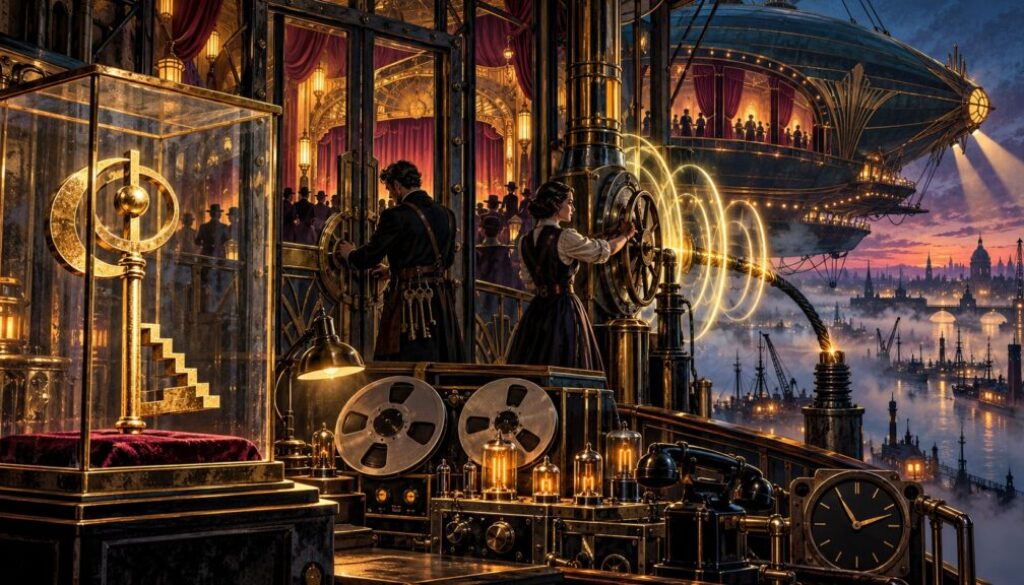
Inside, the Skylark Theater had been threaded into the armature of a retired mail-carrier: velvet thrown over steel, gilt charms tied to rivets, a proscenium where the sorting tables had stood. A glass case by the corridor carried a single gilt key on blackout velvet, gleaming like a scrap of sun.
“Miss Vale, we adhere to sequence here,” said a tall man with a ledger in one hand and a pocket watch in the other. “We do not bring tradesmen into the radio room. Sir, you will attend to your work and keep hands off apparatus. Doors open at eleven thirty, not one minute before or after.”
“Who cut this?” I found myself in front of the case without memory of crossing to it. The keys teeth pointed inward, like a staircase inverted. “Thats impossible,” I said before the thinking part of me caught up. “No wards respect that geometry. It should open nothing, or everything it shouldnt.”
“Prop trunk oddity,” Mira said, already tugging me by the sleeve. “Come see whats fouled in the headroom. If he insists on rules,” she added under her breath, as Mr. Hargrave arched a brow, “well call it a preview adjustment. Youll want your ears more than your picks tonight.”
The radio room had been a postmasters office once, blinds drawn against the harbor lights. Racks of dials and valves breathed a soft orange. On the desk, a spool of tape sat threaded and ready, its label neat and bone-white: Conversation 11:41 pm. It was, by the wall clock, ten fifty-two.
“If thats really happening, then we have less than nine minutes.” The voice on the tape was mine, warmed by hiss, carrying a steadiness I had not yet had the chance to earn.
“I can hold the frequency until the doors open, but you have to choose the lie we follow.” Miras recorded voice came next, soft but iron-filament strong under the static, like a hand that had learned to hold trembling china and never let it break.
“Thats me,” I said, feeling the room narrow. “I havent said those words.” The tapes hiss went on like the sea under everything, as if waiting for us to catch up to the shoreline it already knew.
“And thats me, after a cup of time I havent drunk,” she whispered. She put two fingers to the cabinet, listening through skin and metal. “Echoes skip on the ionosphere some nights. I never thought speech could skip forward.”
“I will not have theatrics in my communications,” Mr. Hargrave said from the doorway, yet his hand had crept to the back of his collar, as if checking whether his own voice box still belonged to him. “Miss Vale, cut that. Sir, say plainly what you did.”
The desk telephone rang with the ugly insistence of a cafeteria bell. Mira and I looked at each other and then at Mr. Hargrave, who, by rights, should have answered it. The ledger trembled just enough to disturb a page corner.
“Ill help you,” said a voice that had all the warmth hammered flat out of it by distance. “Lock the stage doors at eleven twenty-seven and keep them shut, no matter who screams. Promise me.” The line sang with a thread of feedback that made the hanging bulbs blush.
“Who are you to ask for that? Lives depend on these doors.” I found my hand on the receiver before I remembered the ledger and the watch and Mr. Hargraves frown like a fence.
“Your best chance. Im the piece that doesnt fit until you see the whole lock. Im the crack in your key. Keep them shut from twenty-seven to thirty, and vent the Resonance Cabinet to ground.” The click of teeth came through, like a dry smile against a mouthpiece.
“Contradictions,” Mira said, eyes brightening the way a night watchmans lamp does when a shadow proves not to be a thief. “Program card says, Open 11:30 on the dot. Tower beacons been blinking NEVER in Morse for half an hour. Tape tells us to hold until doors open. Caller says lock. Its a chain.”
“We do not close against paying patrons without cause enumerated.” He set the ledger on the desk, opening to tonights columns as if the numbers could grant absolution. “Demonstrate a material hazard, Miss Vale. Not a mood. Not a parlor tale. A reason I can write.”
The gilt key in the glass, innocently gleaming, drew me as a lodestone draws a needle. Up close the teeth reversed and mirrored their own negation, a map of absence. It did not ask to open, I thought. It asked what would happen if a closed thing learned itself from the inside out.
“Some keys work by opposition,” I said, and my voice steadied to the degree that other peoples safety demands you borrow calm from whatever you can. “A liars chain. If an instruction appears once, invert it. If it appears twice, invert the inversion. The beacons NEVER and the cards OPEN cancel. The tape asks us to wait until we openthats one lie. The call adds a second constraint: lock until twenty-seven to thirty, then vent. Odd count points to the caller.”
“And the times line up,” she murmured, already at the dials. “The cabinets hum is building on a five-minute envelope. If we open at the top of it, the audience becomes a resonator. If we hold through the crest and ground the bleed, the tone dies before it can feed. I can catch the crest if you keep the doors shut.”
“Three minutes,” he said, looking from the watch to our faces as if hunting for forgery. “From eleven twenty-seven to eleven thirty we mark the outer doors technical rehearse. If this proves to be theater, understandI close you both down by morning. If it proves to be hazard, we do not speak of it at all.”
Below, the crowd was arriving in salts and satins, their talk rising like the sound of birds disturbed at dusk. The minute hand crept with a prosecutors patience. Somewhere in the hull a panel ticked as it warmed, like the herald of a heart preparing for sprint.
“Now,” the voice breathed when the watch hand stuttered toward twenty-seven. “Trust that this hurts less than the other choice.” The line did not wait for agreement; it simply stayed, as if staying were all the presence it could legally manage.
“Hold fast,” I said, and I slid the great exterior bolts as Mira had shown me, feeling the iron slow under my palm like an animal asked to lie down. Knuckles rapped the glass beyond, then fists, the protest of the punctual who had not been warned.
“Here comes the crest.” She had both hands on the Resonance Cabinets wheel, eyes unfocused the way musicians go when they listen for a note inside a note. “On my word, open the ground. Not before. Not after. Now. Vent open. Let it spend itself into the earth.”
The deck thrummed as if some great thing beneath the river had decided to climb aboard. Lamps shivered. For a breath the whole theater went light and then lightless, then found itself again, a creature that had sneezed and remembered its lungs. The pounding at the doors became questions, then jokes. The watch struck thirty.
“We will never speak of sealed doors again,” he said, not as a verdict but as a vow. His hands were steady on the bolts as we drew them back. “Ladies and gentlemen, forgive the delay. A little hush in the line, please. Welcome aboard the Skylark Theater.”
“If thats really happening, then we have less than nine minutes,” I said to Mira in the dim of the radio room at eleven forty-one, hearing myself fall into the sentence like a bead into the groove it wore for itself. This time my mouth made the words for the first time and the second together.
“I can hold the frequency until the doors open, but you have to choose the lie we follow.” She smiled without humor. “We chose already, I think. The world is tidier when causes obey before effects, but tonight the order took a bow and let its understudy on.”
The telephone, patient as tide, hummed again. I did not look to Mr. Hargrave this time; his back was turned to the stage, counting heads like a priest keeping score with his conscience.
“You kept them alive,” the voice said, almost warmly now that it could afford temperature. “Leave the key where you found it. Do not look for me. Keep the promise that made you dangerous and decent in the same minute.”
“I promised three minutes, and I kept them,” I said, touching the glass a breath away from the gilt, feeling the cool memory of metal without smearing it. “And Ill leave your impossible thing where everyone can see it and swear it opens nothing at all.”
The audience settled into its laughter and gasps, generous as congregations who do not know the sermon has already delivered them. The Skylark, light on her moorings again, lifted a patient inch against the river fog. In the glass the backward key held every answer it denied, and for once the night kept quiet about what it knew.
Featured image credit: Personal image selected by editor.