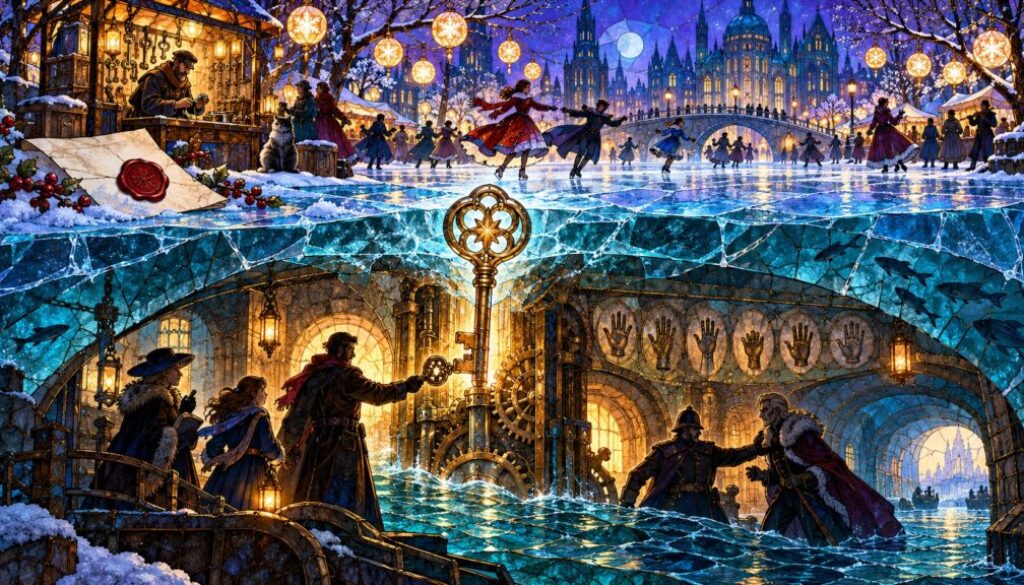
The Wake-Key of Winter Canal
Snow lamps swung over the frozen canals as the winter carnival crowded the ice, and at a small stall of blued steel and filings, a quiet locksmith honed teeth into brass with a patient hand.
“Where did you get this?” He turned the heavy key beneath the lamp, its facets catching a pale tremble of river light under the ice.
“Family effects,” he said, all silk and frost. “A steamer trunk dredged from an estate sale upriver. And I am told you are the only man who can make it answer.”
Silas Reed had filed thousands of cuts and chased a thousand locks, but the warding on this key was a rumor he had once traced in soot and destroyed. It was impossible—and perfectly real.
“I will need time to take impressions,” he said, steadying his breath. “The work is delicate, and your trunk seems to have wandered through stories.”
“You look as if you’ve put your hand in a ghost,” the woman in the sable hat murmured, stepping from the crowd. “May I? The crest on its bow is old canal-law. I study such things.”
“That’s the key we hid from the snowfire night,” said a young woman wrapped in a sailor’s coat, more certain than shy. “I remember its teeth in my hand, though I only came back this week.”
Trumpets flared on the ice. A ring of men in fine boots shouldered a path clear to Silas’s stall, and their leader lifted a parchment bearing a blood-red seal that gleamed like a winter berry.
“Citizens of the Canal District,” he called, eyes bright as cut glass. “By the Founder’s Contract, revived, all sluices, tolls, and safeties fall under my stewardship at noon tide. The law remembers what men forget.”
“If that seal is true, the district bends its knees,” the marshal said around his scarf, chewing each word. “I don’t like it, but law is a chain.”
Silas bent as if to admire the seal. The wax was flawless, the ribbon correct—but there at the rim, a burr no eye but a fileman’s would catch. And the paper smelled of yesterday.
“This is clever work,” he said softly. “Too clever. The ribbon’s slub is wrong, and the wax took an imprint from a mold that was too warm. Someone has been replacing truth in passing.”
“The ink sits on the fiber like a child on a gate,” she said, her scholar’s delight smothered by anger. “It hasn’t drunk in. Fresh. They have perfected forgery.”
“They can swap pages and seals, but they can’t copy a warning written by six hands in a flood,” she said, voice low. “It’s under the ice, and the only passage will seal with the next tide.”
Silas tucked the impossible key into a chamois wrap and nodded, feeling the weight of its old promise. Dr. Kett and Ana slipped behind the stall ropes; they dropped to a maintenance ladder rimming a culvert.
“If this turns to silliness, I was never here,” the marshal muttered, following with his lantern. “But I won’t have a district stolen while I nap on skates.”
Below the carnival’s music, the world ticked and breathed. The canal’s underpass smelled of iron and fennel, and on a curved wall chalk scrawl, charcoal strokes, and knife-scratched notches ran like ivy—too many hands to counterfeit.
“Start here,” she said, dusting frost from a line. “Hold fast three words above water—wake binds law. I carved that with a fishknife when the lamps blew out.”
“This second hand is Fargast’s, a founder’s clerk,” she said, squinting. “It moves dates like anchor stones. Here: ‘Spring tide opens one bond and one only.’ And beneath—see the cramped protest?—‘Name it with the key.’”
“Years ago,” he said, the cold finding him, “a collector bade me trace a legend. I pressed its wards into soot and beeswax, then burned the molds. I thought I burned the sin with them.”
Piecing the hands together, the message grew. A machine beneath the Gatehouse—the Charter-Engine—yoked law to water. At spring tide, a single binding could be loosed by key and word: a contract, an oath, or a death inscribed in canal-rolls.
“My Theo slid through Blackstairs three winters back,” she said, each syllable like a nail tapped true. “We put his name in the river book. If a word could call him home—”
“If we use it to release death, Corin’s claim stands over us for a generation,” she said, not unkind. “If we break the contract, the river keeps what it has taken. There is law, and there is love.”
“How touching,” Sir Corin said from the shadows, his men’s lanterns slicing the frost into coins. “But you rummage in drains for myths. I came for a mechanism and a moment.”
“Name the moment you mean to buy,” Silas said, keeping the lamp from his face, the wake-key a stone in his palm.
“Spring tide and noon, of course,” he said with a smile sharp enough to shave. “Help me open the engine, Reed, and I’ll show you river records you have wept over. Lio Reed, wasn’t it? Kettle Lock, dark in March.”
The marshal stepped between them, solid as a post, and Dr. Kett’s fingers danced over chalk. Below, the water rumbled like a slumbering ox that would not be kicked twice.
“Here,” she breathed. “Six hands argue. ‘Charter,’ writes the clerk. Someone scratches ‘child’ across it; someone else writes ‘river’ and underlines it thrice. The law itself was in quarrel that night.”
“I wrote ‘child,’” Ana said. “We were soaked, shivering, and the machine thrummed like a heart. We could not agree which heart to let beat on.”
“I wasn’t here then,” he said. “All I knew was a rumor and a trader with soft hands. But I know this: a counterfeit contract can crown a thief. ‘Charter’ is the city, and a city is more than a single name.”
They climbed the narrow iron steps to the Gatehouse, where a bronze panel slept in frost like an old turtle. Above, muffled waltzes thinned into the cold as the tide clock tolled its last quarter.
“Choose,” the marshal said, setting his boot against the door to keep the nobleman nervous. “I will handle any man who tries to put his hand on your shoulder.”
“I already have what I need,” Sir Corin murmured, sliding a glinting blade toward the slot. “A key of my own—cleaner than your relics.”
“And wrong,” Silas said, his voice a quiet file. “That third tooth will jam and strip the wards. Either you break the engine or the engine breaks you. Step back.”
He drew the wrapped object from his coat, the wake-key heavy as another life. Bronze met bronze with a click that sounded like history confessing. The panel woke; gears below sang like ice under sunlight.
“Say ‘child’,” Ana whispered, not pleading, only naming the road she had walked to its end. “Say it and make the river answer for once.”
“Say ‘charter’,” Dr. Kett said, every syllable exact. “Free the future from a predatory past. We cannot all be rescued from yesterday, but we can prevent a thousand tomorrows from drowning.”
“I mend what holds us,” he said, and the tide bell gave its clear last note through the floor. “A city is a lock. It must close before it keeps anything safe.” He leaned to the old mouth of the machine and spoke one word: “Charter.”
The bronze took the word as if it were a coin or a prayer. The engine shuddered, then drew a breath that tasted of brine and law. Paper cracked, seals melted without heat, and somewhere far above a proclamation died in a man’s throat.
“You miser,” Corin snarled, lunging before the marshal’s arm clotheslined him. “You squandered a miracle on commoners and cobbles.”
“On a district,” Hosk said, folding him down to sit on his dignity. “That’s what you tried to pocket. Stand quietly or enjoy the ice.”
Water boomed beyond the walls as the tide turned, sealing the culvert’s throat with a clean, iron certainty. The warning on the tunnel would wash away with the freshness of its victory, which is perhaps what warnings hope for.
“Why did you choose as you did?” Ana asked when the music above found them again and the air tasted of spun sugar and frost. “Tell me the true reason, not the noble one.”
“Because I would not trust us with that kind of longing,” he said. “Not me, not any of us. If I’d said ‘child,’ what would stop the next man from saying ‘mine’? Locks exist because we all have reasons.”
“The river keeps its dead, but the city keeps its names,” she said gently. “Come to the archive tomorrow. We will write Theo Ilyin into the first book of saved things—those we choose to remember.”
They stepped into the lantern-lit swirl of skates and fiddles. Sir Corin’s men drifted away like smoke before a clean wind, and the seal on his parchment had turned to a smudge upon his glove.
“I didn’t see a thing,” the marshal said, tugging his scarf up and his cap down. “But if anyone asks, tell them the ice sang particularly well this year.”
Silas weighed the wake-key once more, then set it on the bronze lip of the panel. Frost took it back from his fingers and crept over its wards like closing eyes. He let it go; some doors should not be opened twice.
“I remember more now,” Ana said as they walked, the carnival’s bells catching on her smile like stray snow. “Not the miracle, but the night, and the hands that wrote together. That will do me better.”
The winter carnival spun on. Up on the ice, a child laughed at a paper lantern shaped like a fish, and down in the dark the city’s machine slept, bound to the tide and to a word chosen for the common good.